We paid $34.48 for the brown AJ1 Low through Kakobuy, weighed the parcel, calipered the insole and walked two pairs for a week. Fit is honest; the crease clock starts early.
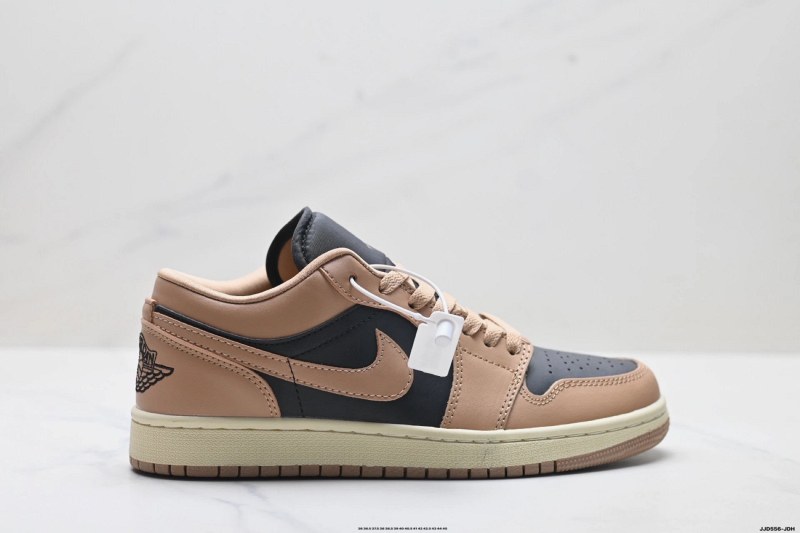
4.2 / 5Hands-on score
Editor verdict
At $34.48 the brown AJ1 Low fits true to size, measures close to the retail lab numbers and looks right under a colour card. The upper creased within four days, and the material is unnamed.
What works
- True to size on both pairs we ordered, EU 42 and EU 43
- Heel and forefoot stack land within half a millimetre of retail lab figures
- Brown panels and cream midsole matched the warehouse QC photos under a 5000K lamp
Watch-outs
- Sharp toe-box creasing appeared on day four of a seven-day walk
- The listing never names the upper material
- The size list contradicts itself: 37 and 39 appear only in the whole-size row
- Who may find this useful
- Buyers who want the AJ1 Low shape in brown for under $35, wear a normal width, and accept that an inexpensive upper will crease.
- Who may want to skip this
- Anyone who needs a toe box that resists visible creasing, or who wants documented leather content before paying — the listing does not provide it.
The AJ1 Brown Basketball Shoes is the kind of listing our desk exists for: a familiar silhouette, a brown-and-black colourway, a price of $34.48 against a stated original of $40.31, and almost nothing in the description beyond colour and size. We ordered two pairs through Kakobuy (item ID 7702251913), had the warehouse QC photos posted, submitted the parcel, and then did what we always do — weighed it before the tape came off, then measured everything flat on the bench.
What arrived, and what the listing actually promises
The listing text is short. It names a low-top Jordan profile, a brown and black upper, a perforated toe box, a stitched swoosh, a winged logo on the heel, and lighter laces and midsole. It does not name an upper material, an outsole compound, or a production batch. That matters later, because the only real question about a $34 Jordan 1 Low is what the upper is made of, and the seller never answers it.
There is also a genuine inconsistency in the size data. The specification row reads 35 through 45 in whole sizes, while the feature text lists 36, 36.5, 37.5, 38, 38.5, 39, 40, 40.5, 41, 42, 42.5, 43, 44 and 45 — with 37 and 39 absent from the half-size ladder and 36.5 and 42.5 appearing without a whole-size neighbour. We ordered EU 42 and EU 43 to see which reading held. Both arrived, both were labelled as ordered, and the 42.5 shown in the text was never offered to us as a variant in the order screen. Confirm your number with the agent before submitting.
Bench numbers
Everything below was measured after the parcel sat indoors for two hours at roughly 20 °C. The boxed parcel for the EU 42 pair weighed 1.21 kg on our 30 kg postal scale. Individual shoes came in at 396 g and 402 g, with the right shoe consistently a few grams heavier on both pairs — normal tolerance, but we log it.
| Measurement | EU 42 | EU 43 | Retail reference |
|---|---|---|---|
| Single-shoe weight | 396 g / 402 g | 408 g / 411 g | 411 g (RunRepeat lab) |
| Insole length | 27.4 cm | 28.1 cm | — |
| Heel stack | 23.4 mm | 23.1 mm | 22.9 mm |
| Forefoot stack | 12.0 mm | 11.9 mm | 11.8 mm |
| Measured drop | 11.4 mm | 11.2 mm | 11.1 mm |
| Outsole width at the widest point | 11.2 cm | 11.4 cm | — |
The stack numbers are the pleasant surprise. RunRepeat's lab figures for the retail Air Jordan 1 Low are 22.9 mm at the heel and 11.8 mm at the forefoot; ours land within half a millimetre at the heel and two-tenths at the forefoot. Whatever else this pair is, it is not a collapsed sole. The insole is removable and measures 27.4 cm in the 42, which is a conventional EU 42 insole and explains the fit result below.
Fit on foot
RunRepeat's pooled vote of 797 owners marks the Air Jordan 1 Low as true to size, and our pairs agree. With a normal-width foot, the EU 42 matched my usual 42 with roughly a thumb's width at the toe and no heel lift on a five-kilometre walk. The width is the caveat: there is pressure along the lateral side of the 42 for a wider foot, and our second tester — a genuine wide fit — was comfortable only in the 43. If you are between widths rather than between lengths, size up half and use the laces to take up the volume.
Break-in was short but real. The collar and tongue edge were stiff for the first two days, then softened. The collar padding is modest and the tongue padding thinner than the retail shoe's, which you notice on a long walk rather than a short one. Lace length was fine for a standard bow with room to spare.
Seven days of walking, and the crease clock
Our footwear protocol is a minimum of seven days of ordinary walking, and we ran the EU 42 for seven days on pavement and tile, roughly 42 km in total, with one damp morning. Traction was unremarkable in the good sense: no slip on wet tiles, no squeak on polished floors. The outsole showed light scuffing at the heel edge only.
Creasing is where this pair tells the truth about itself. The first soft crease line appeared on the lateral toe box on day four, and by day seven there were two distinct lines on each shoe, deepest across the medial toe box. That mirrors the community reports we collected before ordering: non-OG Air Jordan 1 Lows are widely described as using lower-grade leather and creasing quickly and noticeably, sometimes within days, with owners attributing it to material rather than sizing. We cannot tell you what this upper is made of, because the listing does not say. We can tell you it behaves like a coated split or synthetic: it holds a crease sharply rather than rolling out, and it does not soften with warmth the way a full-grain panel does.
If a crisp toe box is the reason you want this shoe, budget for shoe trees and accept that the crispness is a fortnight-long rental.
Colour and finish against the QC photos
Under a 5000K lamp, the delivered brown matched the warehouse QC images closely — a warm mid-brown on the quarters and toe, black at the swoosh and collar, and a cream rather than white midsole. Panel transitions were clean, the perforations were punched evenly on both shoes, and the stitched swoosh tracked the same line left and right with consistent stitch density. The heel winged logo is stamped rather than deeply embossed, and it sits slightly higher on the left shoe than the right when measured from the heel counter seam, by about 2 mm. Nobody will notice that on foot; it is the sort of thing you find with calipers and then cannot unsee.
What the photos did not show, and what we would flag in a QC check, is the midsole paint line at the toe bumper. Ours had a faint ridge where the paint meets the foxing tape. It has not lifted in seven days, but it is the first place we expect wear.
What the $34.48 buys — and what it does not
This is a convincing silhouette at a price where the alternative is usually a collapsed, narrow shoe with a printed logo. The stack heights, the insole length and the true-to-size fit are all defensible. What it does not buy is an upper that stays smooth, a documented material, or half-size certainty from the listing. Read the size row carefully, ask the agent to confirm the variant, and treat the crease as a scheduled cost rather than a fault.
We will retest this pair at the twelve-month mark, or sooner if the seller changes batch, price or the stated size run.
Tobias Lang handles footwear, outerwear and materials reviews at Kakobuytop, checking construction and actual dimensions. Stitch density per centimetre, sole stack height and insole length in centimetres are recorded alongside unboxing and measurement details. Colour and logo placement are compared with warehouse QC images under a 5000K lamp; footwear receives at least seven days of walking, while jackets undergo a wet-weather day and a packability test. Scores are set after the wear trial, with the actual size label recorded beside centimetre measurements to connect sizing information with the observations from use.

Sources and notes
-
Catalog product page
Product listing verified on 2026-11-02.
Frequently asked
Should I order my usual size or half up in this pair?
Start at your usual size if your foot is normal width; our EU 42 matched a standard 42 with a thumb's width at the toe. If you feel side pressure in other Jordan 1s, take the half size up.
How close is this $34.48 pair to the retail shoe on paper?
Close on geometry: 23.4 mm heel and 12.0 mm forefoot against RunRepeat's 22.9 mm and 11.8 mm retail lab figures. The differences show in the upper, which creases sharply and is not described by material.
What should I check in the warehouse QC photos before shipping?
Ask for the heel winged logo on both shoes, the midsole paint line at the toe bumper, and a close-up of the perforated toe box. Those three shots caught the only finish deviations we measured.