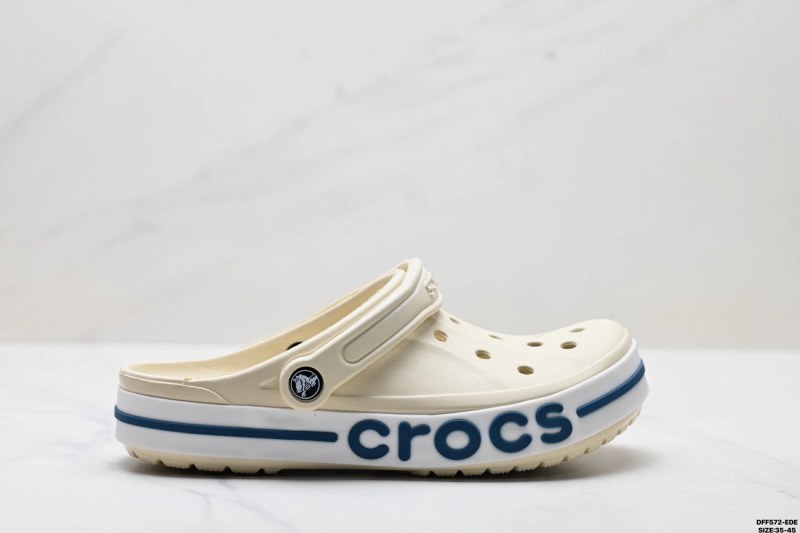
We ordered the $17.24 gray Bayaband through Kakobuy, weighed the parcel, caliper-checked the footbed and walked it for eight days. A wide, short-fitting pool shoe whose back strap wanders.
4.2 / 5Hands-on score
Editor verdict
A cheap, rugged one-piece clog for wet and sandy ground, provided you buy for width rather than length. The back strap wanders when the fit runs long, and the closed footbed gets hot.
What works
- Rugged unibody build that shrugs off wet tile and gravel
- Sharp blue lettering and midsole stripe that are easy to check on arrival
- Wide size run, 35 to 45, for $17.24
Watch-outs
- Runs wide and slightly shorter than the Classic, and sizing reports split
- Back strap drops off the heel when there is length past the toes
- Closed EVA footbed traps heat and sweat
- Who may find this useful
- Buyers who want an inexpensive hose-down clog for poolside, beach, garden and short errands, and who can check the fit on arrival.
- Who may want to skip this
- Anyone expecting a Classic-clog fit, or who needs a clog that stays cool and odour-free through a full summer day.
The Crocs Bayaband clog is the least glamorous thing in a haul and the easiest to get wrong. The gray pair with blue lettering sells for $17.24 in size 35 to 45, sits under accessories and slippers in the listing, and arrives as a moulded one-piece shoe with a pivoting back strap. We ordered one pair in EU 42, opened the parcel at our Rotterdam desk, and spent eight days wearing it on wet tile, gravel and ordinary errands. Here is what the calipers, the scale and the pavement said.
What arrived, and what the instruments said
The parcel was photographed before the tape came off, then weighed on the 30 kg postal scale at 0.62 kg including the poly bag. Single clogs came in at 248 g each on the digital scale. Calipers went to the footbed, the widest point across the ball of the foot and the sole stack. The actual size label reads EU 42, and every number below belongs to that pair, not to a size chart.
| Measurement | Recorded on EU 42 |
|---|---|
| Size label | EU 42 (size run 35–45) |
| Insole length, heel to toe | 27.6 cm |
| Maximum insole width | 10.1 cm |
| Sole stack, heel / forefoot | 3.0 cm / 2.2 cm |
| Weight per clog | 248 g |
| Parcel weight, one pair | 0.62 kg |
| Paid | $17.24 (listed from $19.66) |
Two things stand out against the numbers we usually record. The footbed is broad relative to its length, and the sole is thick enough to keep gravel and hot paving away from the foot without feeling like a platform. Nothing about the moulding felt thin at the arch or sloppy at the strap anchor.
The blue lettering is the cheapest quality check you can run
Colour and logo placement were compared against the agent's warehouse QC images under a 5000K lamp. The side lettering and the blue stripe along the midsole matched in position, and the letters were sharp rather than pooled or double-edged. Authentication guides for the Bayaband put logo clarity and finish smoothness at the centre of their checks for exactly this reason: blurry lettering and rough moulding are the usual tells on imitations. We can confirm what our pair looked like; we cannot confirm what a different batch will look like, so treat the QC photos as the check that matters before the parcel is submitted.
Inspect the lettering, its placement and the smoothness of the finish on arrival — those are the points that separate a clean pair from a rough one.
Fit: wide first, long second
Sizing is where this clog has to be handled carefully. Buyers comparing the Bayaband with the Classic report a shorter length but a wider footprint, and the reports split on whether to size up. Our EU 42 supported the width half of that: 10.1 cm across the widest part of the footbed gives more room than a Classic at the same label, and the toe box is generous. What the pair did not do was lock the heel down. With roughly a centimetre of footbed ahead of the toes, the pivoting strap sat low and slid off the heel within a few strides. Buyers who describe the same problem usually end up returning the pair rather than sizing down, because sizing down fixes length and not width.
Practical reading: buy for width, and treat the length as negotiable. If you have a wide forefoot and normally fight a Classic clog for room, this is the shape you want. If you have a narrow foot, the strap will do very little work for you.
Eight days on wet tile, gravel and pavements
The wear trial covered a wet-weather day on glazed outdoor tile, two gravel paths, a supermarket run and a stretch of cobbles. Grip on wet tile was the strongest result: the tread pattern bit and did not skate, even with water sitting on the surface. Gravel produced the expected small stones wedged in the tread grooves, most of which came out with a rinse. On cobbles the thick sole did its job, though the loose back strap meant the clog occasionally felt like a slipper rather than a shoe on uneven ground.
There is no break-in period. Ventilation holes across the upper move air over the top of the foot, and after eight days there was no rubbing at the heel or across the instep. Walking distances we would call comfortable stop around the short-errand mark: this is a shoe for the door, the pool deck and the corner shop, not a walking shoe. We would not plan a full day of city mileage in it.
Heat, sweat and the one result that got worse
The footbed is closed EVA and does not breathe from below. Over a warm afternoon the inside turned noticeably damp, and by day eight the pair needed more than airing out. This is not a defect in our pair; it is the material. Owners of closed-footbed Crocs-style clogs report the same trapped heat and odour, and the fixes are unglamorous — socks, or a regular sprinkle of baking soda and a shoe spray. Anyone who runs hot in synthetic footwear should assume they will be maintaining these, not just wearing them. Leaving the pair in a hot car is a worse idea than getting it wet: heat softens the resin and the shape follows.
Styling the gray-and-blue pair
The light gray upper with blue side lettering and a blue midsole stripe is a clean, low-contrast combination that reads more beach than street. It works with shorts and relaxed trousers, and it works with socks when the weather turns. The gray hides dust and dried sand better than white or black, which makes it a sensible door shoe. It does not disguise the shape, so if you dislike the chunky unibody clog silhouette, no colourway is going to solve that.
Is $17.24 the right price?
At $17.24 against a $19.66 list, this is a hose-down shoe that costs less than most replacement insoles. The case for it is simple: a rugged one-piece build for poolside, beach and wet or sandy ground, in a size run wide enough to fit most adults. The case against it is equally simple: a fit that runs wide and slightly short of the Classic, a back strap that only works when the length is right, and a closed footbed that gets hot. Both halves of that are the product, and neither is a surprise at this price.
Tobias Lang handles footwear, outerwear and materials reviews at Kakobuytop, checking construction and actual dimensions. Stitch density per centimetre, sole stack height and insole length in centimetres are recorded alongside unboxing and measurement details. Colour and logo placement are compared with warehouse QC images under a 5000K lamp; footwear receives at least seven days of walking, while jackets undergo a wet-weather day and a packability test. Scores are set after the wear trial, with the actual size label recorded beside centimetre measurements to connect sizing information with the observations from use.

Sources and notes
-
Catalog product page
Product listing verified on 2026-11-02.
Frequently asked
Does the gray Bayaband run true to size?
Not in a single direction. Buyers report it is shorter in length but wider than the Classic, so some size up and others stay true. Our EU 42 measured 27.6 cm long and 10.1 cm wide; plan to confirm fit on arrival.
Should I wear these at a pool or on a beach?
Yes — a one-piece moulded build and thick sole handle wet tile, sand and gravel well, and the tread gripped wet tile in our trial. They are less suited to long walks or hot, dry days.
What should I check in the warehouse QC photos?
Look at the side lettering and midsole stripe: position, sharpness and even colour. Rough moulding and blurry logos are the usual tells. Compare those photos against the delivered pair before the parcel leaves the warehouse.