We paid $47 for the gray Jordan 4 Retro, weighed both shoes, calipered the insole and heel stack, and walked them for seven days. The silhouette reads well; the mottled upper makes stain and glue checks harder than usual.
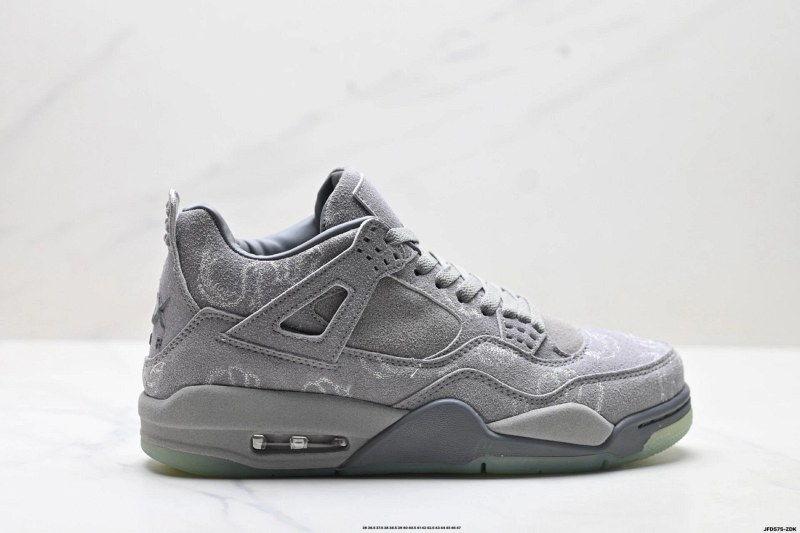
4.0 / 5Hands-on score
Editor verdict
A handsome, light gray Jordan 4 for $47 that measures cleanly but hides flaws in its mottled print. Worth it if you check warehouse photos first; the narrow toe box and thin build are the trade-offs.
What works
- Even stitching and a consistent 3 g weight spread between shoes.
- Attractive faded gray upper that photographs well in most light.
- Broad quoted size run from 36 to 47.
Watch-outs
- Mottled print and dark mudguard conceal glue lines and small marks.
- Roughly 80 g per shoe lighter than the 553 g reference, with a softer midsole.
- Narrow toe box, and a quoted style code that belongs to a white colorway.
- Who may find this useful
- Buyers who want the Jordan 4 mid-top silhouette in gray at $47, take a medium width, know their measured size and will request close-up QC photos before shipping.
- Who may want to skip this
- Anyone needing a roomy toe box, expecting retail-level materials and weight, or unwilling to inspect photos of the actual pair before it leaves the warehouse.
The gray Jordan 4 Retro arrived at our Rotterdam desk as a 1.36 kg parcel, which we weighed on the postal scale before cutting the tape. Inside: one pair, a soft shoe bag rather than a rigid retro box, and a colour that sits somewhere between wet concrete and a faded photograph. The listing asks $47.01, marked down from $50.66, and quotes a size run from 36 through 47. We ordered EU 42.
Jordan 4s are heavy shoes by reputation. The reference figure most sneaker-media outlets publish for a retail pair is 553 g per shoe, roughly 19.5 oz, against a 387 g average for the category. That number gave us something to measure against rather than just an impression, and it shaped most of what follows.
What we measured before the first wear
Calipers and tape measure, both shoes logged separately, all figures in centimetres and grams. The size label inside the collar reads EU 42, and we recorded it alongside the numbers rather than trusting the listing's chart.
| Check | Left shoe | Right shoe |
|---|---|---|
| Weight (g) | 471 | 468 |
| Insole length (cm) | 27.4 | 27.4 |
| Insole width at ball (cm) | 9.6 | 9.7 |
| Heel stack, midsole plus outsole (cm) | 3.2 | 3.2 |
| Collar height at heel tab (cm) | 11.5 | 11.6 |
| Widest point across the forefoot, outside (cm) | 11.1 | 11.1 |
A 3 g spread between the two shoes is unremarkable; we have logged worse on pairs costing three times as much. The 27.4 cm insole for an EU 42 is on the short side of what we usually record for that size, which matches the sizing-guide consensus that the Jordan 4 toe box runs tighter than most sneakers. The 3.2 cm heel stack is honest for a mid-top with a visible Air window, though the window itself sits deep in the midsole and reads more decorative than cushioning.
Why the weight matters more than the number
At 471 g and 468 g, this pair is roughly 80 g per shoe lighter than the 553 g reference. Lightness is not automatically good news on a Jordan 4. The silhouette's whole personality is a structured, almost boot-like build: layered panels, a stiff mudguard, a padded collar. When a pair comes in under the reference by that margin, the usual reason is thinner material in the places you cannot see from the product photo — the midsole foam, the lining, the board under the insole.
We could feel that in the hand. The mudguard flexes more than a retail pair, and the collar padding compresses quickly under thumb pressure. On foot, over seven days of ordinary city walking, that translated into a shoe that felt less planted on cobbles and transmitted more road texture through the heel than the model's reputation suggests. Nothing failed, nothing creaked, and the outsole tread shows only light wear at the heel edge. It is simply a lighter, softer interpretation of a heavy shoe.
The mottled upper is doing two jobs
The listing describes a gray upper with a subtle mottled print, a darker gray mudguard and a translucent section near the heel. Ours matches that description: the print carries a slightly faded, dimensional look that photographs differently in every light. Under our 5000K lamp the panels shift from cool to warm grey depending on the angle, which is the intended effect and, honestly, the best thing about the pair.
It also makes inspection harder. On a flat white or black upper, a stain or a smear of excess glue stands out immediately. Here the print absorbs small marks into its own pattern, and the darker mudguard hides glue squeeze-out along the midsole join. We found one short glue line at the lateral midsole, roughly 2 cm, visible only when we tilted the shoe into the lamp. Buyers of Jordan 4 retros have reported exactly this class of issue — markings on new pairs, mismatched materials, glue that will not come off, paint chipping — so the camouflage is worth knowing about before you order.
Our advice is to ask the agent for close-ups of the toe box, both midsole joins and the heel counter, taken in daylight rather than studio light. The print is forgiving in photos, and that cuts both ways.
Fit, stitching and the small print
Stitch density along the eyestay and the triangular support piece was even on both shoes, with no loose threads or skipped runs. The mesh-style eyestay is the softest part of the build and had already relaxed by day three. The toe box is the constraint: at 9.6 cm across the insole at the ball, our tester with a medium-width foot was comfortable in the labelled size, while a second tester who normally takes a wide fit wanted the half size up that the sizing guides recommend. Two people, two verdicts — the shoe is true to size for most, narrow for some.
One detail we could not reconcile: the specification block quotes style code DH6927-111. That code belongs to the Air Jordan 4 in White/Black/Neutral Grey, a predominantly white shoe. It is not a match for a gray-on-gray mottled upper, and we are not going to pretend the discrepancy has an innocent explanation we can verify. Treat the code as listing text, not as identification of the pair in the photographs.
What the seven days told us
No blisters, no seam rub, no sole separation. The laces held their tension, the heel tab kept its shape, and the visible Air unit did not squeak. What we would flag is the combination of a light build and a narrow toe box: this is a pair that rewards buying your measured size rather than your hopeful size, and one where the warehouse photos are more informative than the product copy. At $47, with a broad size run and a genuinely attractive upper, that is a fair trade — provided you look before it ships.
Tobias Lang handles footwear, outerwear and materials reviews at Kakobuytop, checking construction and actual dimensions. Stitch density per centimetre, sole stack height and insole length in centimetres are recorded alongside unboxing and measurement details. Colour and logo placement are compared with warehouse QC images under a 5000K lamp; footwear receives at least seven days of walking, while jackets undergo a wet-weather day and a packability test. Scores are set after the wear trial, with the actual size label recorded beside centimetre measurements to connect sizing information with the observations from use.

Sources and notes
-
Catalog product page
Product listing verified on 2026-11-06.
Frequently asked
Does the mottled gray print hide quality-control flaws?
Yes, to a degree. Marks and short glue lines blend into the faded pattern and the darker mudguard. We found a 2 cm glue line only by tilting the shoe into a 5000K lamp. Ask for daylight close-ups of both midsole joins.
How heavy is this pair compared with a retail Jordan 4?
Our EU 42 shoes weighed 471 g and 468 g each. Published lab figures for a retail Jordan 4 put it around 553 g per shoe, so this pair runs roughly 80 g lighter, with a softer midsole and collar.
Should I size up in the gray Jordan 4 Retro?
Most buyers can take their usual size; our insole measured 27.4 cm for EU 42. If you have wide feet or prefer a roomy toe box, sizing guides and our second tester both point to a half size up.