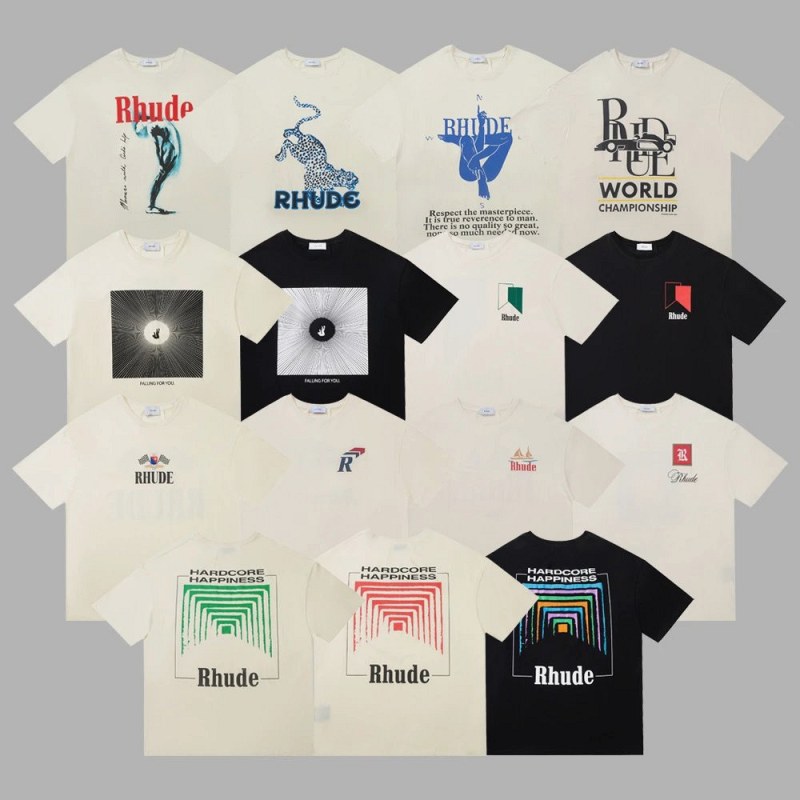
We ordered five variants from the $8.36 Rhude multicolor T-shirt run, weighed each tee and calipered the hems. The print held up; sizing is the one thing that decides whether you keep it.
4.0 / 5Hands-on score
Editor verdict
A combed-cotton, mid-sleeve graphic tee that arrived matching its QC photos and survived two washes without edge lift. The cut is genuinely boxy, but the hem runs tight and the sizing reports conflict, so measure before you buy.
What works
- Combed cotton with a substantial hand; our five tees weighed 198–226 g
- Print edges stayed registered and intact after two 30 °C washes
- Delivered tees matched the agent's warehouse QC photos on colour and logo placement
Watch-outs
- Hem cuts tight on smaller sizes even though the body is wide
- No usable size chart on the listing, only a stated 1–3 cm tolerance
- Buyer reports conflict: some size down, one medium wearer needed an XL
- Who may find this useful
- Anyone who wants a loose, mid-sleeve summer graphic tee and will compare the listing's chest and shoulder numbers against a shirt they already own before ordering.
- Who may want to skip this
- Buyers who want a true-to-size or trim fit, and anyone unwilling to measure first — the boxy block and the snug hem make standard T-shirt sizing an unreliable guide.
What landed at the desk
We ordered five variants of the Rhude multicolor T-shirt from SKU 7718845670 through the Kakobuy agent at $8.36 each — the listing showed a $9.20 original price, so the run was discounted when we submitted the parcel. The option list is long, more than forty print codes across black, white and apricot bodies, and the codes (RH2xx) tell you nothing about the artwork. Photograph the variant you clicked before you submit; the code, not the colour name, is what the warehouse picks against.
Our five: RH235 and RH236 in black, RH219, RH229 and RH238 in apricot, sized M and L. Every parcel was photographed before the tape was cut and weighed on the postal scale, then each tee was measured with digital calipers before it went anywhere near a washing machine.
The 180–250 g claim only holds per piece
The listing states a 180–250 g fabric weight, which is a 70 g band rather than a number. Our five tees all landed inside it, but not near each other.
| Option code | Body colour | Size label | Tee weight (g) |
|---|---|---|---|
| RH235 | Black | M | 214 |
| RH236 | Black | L | 226 |
| RH219 | Apricot | M | 198 |
| RH229 | Apricot | M | 203 |
| RH238 | Apricot | L | 221 |
The spread is mostly size, partly colourway: the black bodies ran heavier than the apricot ones at the same label size, by roughly 10–16 g. That is normal for a dyed graphic tee, and it means the gram figure on the page describes a range you should expect to feel, not a single hand-feel. Against a plain cotton tee, these sit in the substantial middle — noticeably heavier than a fast-fashion blank, not a heavyweight in the sense buyers usually mean when they call a Rhude tee heavy.
Measurements in centimetres
The listing publishes a 1–3 cm tolerance and no chart of its own, so the numbers below are ours, taken flat with the garment relaxed. Size M, one washed-nothing sample per code:
| Measurement | Our size M reading | Rhude's published M reference |
|---|---|---|
| Pit to pit (flat) | 56 cm | 58 cm |
| Shoulder seam to seam | 54 cm | 58 cm |
| Back length | 68 cm | 71 cm |
| Hem width (flat) | 56 cm | Not published |
| Sleeve, shoulder seam to cuff | 22 cm | Not published |
| Collar rib height | 2.2 cm | Not published |
| Hem turn-up allowance | 0.8 cm | Not published |
Read against Rhude's own chart, our size M sits closer to Rhude's S on the shoulder and between S and M on length. That is useful: if you are using the brand chart to guess, you are likely to end up a size too big. The 22 cm sleeve is the mid-length the listing describes — it stops above the elbow and reads more like a cut-off short sleeve than a true short sleeve. Hem width equal to pit-to-pit means the body is a straight block, not a taper, which is what produces the boxy silhouette.
Print registration under the 5000K lamp
We compared every delivered tee against the warehouse QC photos under a 5000K lamp and then checked the print with a loupe. Colour and logo placement matched on all five; no variant arrived looking like a different artwork from the one we ordered. On the black bodies the multicolour lettering and geometric motifs hold clean edges, with no ink bleeding into the cotton and no misregistration where two colours abut — the tightest tolerance is around the thin lettering strokes, and those stayed sharp.
The apricot bodies are the harder test, because lighter grounds show halftone dot structure where the black ones hide it. Two apricot tees (RH219, RH229) showed faint dot texture inside the largest flat colour areas when viewed from about 20 cm; from normal wearing distance it is invisible. Nothing in the print sits proud enough to crack on a fold, and the fill is opaque — no apricot showing through the white elements.
Sizing is the decision, not the tee
This is where the listing stops helping you. There is no chart, only a 1–3 cm tolerance, and the buyer reports we can find on Rhude tees point in opposite directions.
The Rhude sizing discussion is unusually split: one thread advises sizing down because the body runs large and long, while another reports a normal medium wearer needing an XL because "that size was too small on the bottom."
Our samples explain the second half of that contradiction. The block is genuinely wide through the chest and shoulders, but the hem is cut straight to the same width, and the armhole sits low. On the M apricot, the hem pulled slightly across the hips when worn by a 78 kg tester, while the chest still had a clear hand's width of slack. So the shirt is loose where you expect and snug where you do not. There is no measurement error here to blame: the 1–3 cm allowance is stated honestly, and our two M apricot tees differed from each other by 1.5 cm at the hem, which is real variation inside the same option code.
Our advice is unglamorous: measure the pit-to-pit and shoulder of a tee you already like, add nothing, and match it to a listing photo breakdown before you pick. If you are between sizes and want the boxy look, take the larger one — the extra length is easier to live with than a tight hem.
Two washes at 30 °C
All five tees went through two 30 °C washes, no dryer, line-dried flat. Print edges held on every sample: no lifting at the corners of the lettering, no cracking across the graphics, no flaking on the dark bodies. The neckline relaxed by roughly 0.5 cm on one black tee (RH236) and stayed put on the other four. The hem turn-up stayed flat and the side seams did not pucker. The hand softened slightly but the body kept its shape, and the apricot colour showed no noticeable fading or bleed at the graphics.
What we could not verify
- Fibre content is taken from the listing's combed-cotton claim. We did not run a burn or microscopic test, so the exact blend is unconfirmed.
- We tested five codes out of more than forty. The weight spread suggests the remaining options do not all sit in the same place on the spec sheet.
- Print durability beyond two washes is unknown. Two cycles rule out obvious defects, not a season of wear.
- Whether the black and apricot bodies come off the same blank is unresolved; the same-label weight gap points the other way.
Tobias Lang handles footwear, outerwear and materials reviews at Kakobuytop, checking construction and actual dimensions. Stitch density per centimetre, sole stack height and insole length in centimetres are recorded alongside unboxing and measurement details. Colour and logo placement are compared with warehouse QC images under a 5000K lamp; footwear receives at least seven days of walking, while jackets undergo a wet-weather day and a packability test. Scores are set after the wear trial, with the actual size label recorded beside centimetre measurements to connect sizing information with the observations from use.

Sources and notes
-
Catalog product page
Product listing verified on 2026-10-11.
Frequently asked
Should I size down on this tee?
Do not size down blindly. The body is loose and long, which is why some buyers drop a size, but the hem is cut narrow and one reported medium wearer needed an XL. Compare the pit-to-pit and shoulder figures with a tee you own.
How heavy is the fabric, and does it match the listing?
The listing claims 180–250 g, a wide band. Our five tees measured 198 g to 226 g, with black bodies running heavier than apricot at the same label size. All landed inside the stated range.
What sizes and colourways can I order?
The run offers S, M, L, XL and XXL across more than forty print codes in black, white and apricot bodies, with a stated 1–3 cm measurement tolerance. The code tells you nothing about the artwork, so check the option photo.