When you're ready to buy a hoodie from the Drew House brand page on fashion-reps, the first thing to figure out isn't "combining parcels is always cheaper"—it's confirming that the target item, parcel parameters, and route billing conditions are clear enough. Only by recording the item price, shopping agent service fee, payment fee, packaging fee, international shipping fee, and possible taxes separately can you determine whether combining parcels is
Editor score 4.2 / 5
When you're ready to buy a hoodie from the Drew House brand page on fashion-reps, the first thing to figure out isn't "combining parcels is always cheaper"—it's confirming that the target item, parcel parameters, and route billing conditions are clear enough. Only by recording the item price, shopping agent service fee, payment fee, packaging fee, international shipping fee, and possible taxes separately can you determine whether combining parcels is suitable for your current order.📦
This article applies to buyers who plan to discover items on fashion-reps and then jump to their selected shopping agent to complete the order and shipping. According to the fashion-reps page, the Buy button will take you to your chosen shopping agent, and the order, payment, and shipping are handled by the agent's website. Therefore, this site's product page cannot replace the agent's real-time shipping quote, nor can it alone prove that a certain route is currently available.
Verification scope: visible categories, product information, and platform purchase process on the Drew House brand page, recorded on October 14, 2026. Since the current information does not provide the target destination, actual parcel weight, dimensions, route quotes, or payment rates, this article does not output unverified specific amounts.

Clarify the Logistics Decisions to Make Before Combining Drew House Hoodie Parcels
First answer three questions:
- Is the target hoodie still visible on the page, with enough style, color, size, and product details to support ordering?
- After combining the target item with other pending items, will it still comply with destination, route, and packaging restrictions?
- Is the expected savings from combining parcels worth the higher parcel value, dimensional weight, or risk of loss or damage in a single shipment?
Combining parcels is not a default money-saving option. Combining multiple items may reduce duplicate first weights or fixed handling fees, but it can also make the parcel heavier and larger, triggering a new billing tier, or losing eligibility for certain small parcel routes. If the goal is to control loss per shipment, meet route restrictions, or spread taxes and customs clearance risks, splitting parcels may be more appropriate.📊
Record Style, Color, Size, and Currently Visible Item Information from the fashion-reps Page
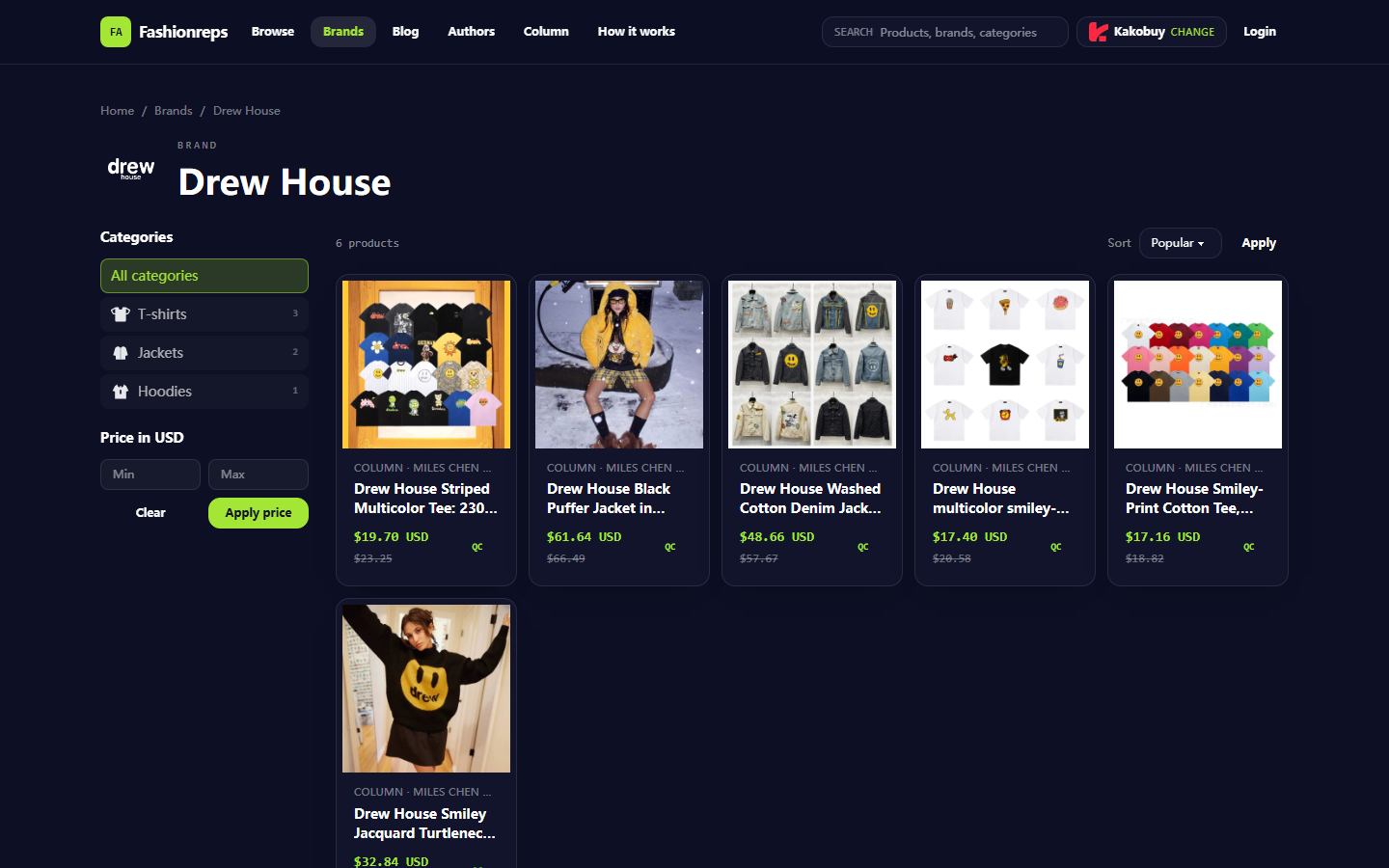
The currently visible summary on the Drew House brand page shows categories for T-shirts, Jackets, and Hoodies, along with product count filter information. The visible product list includes entries such as T-shirts, jackets, and knitwear; however, the provided current evidence does not show the complete name, color, size, weight, or stock status of the target hoodie.
Therefore, when preparing to combine parcels, do not assume the target hoodie can be purchased directly just because there is "1 Hoodie" in the brand category. Open the specific product page and save the following evidence:
- The full product name, product page URL, and page verification date.
- Style, color, size options, and whether the target option is still selectable.
- Price, currency, stock, or purchase status shown on the product page.
- Whether the page provides a size chart, material description, product weight, or packaging instructions.
- Which shopping agent the Buy button goes to, and whether the product information remains consistent after the jump.
If the product page redirects, returns blank, lacks a clear name, or the target color and size cannot be selected, pause adding it to the combined parcel list. Do not replace valid product page evidence with brand category, search summaries, or old screenshots.🧾
Create a Combined Parcel List and Fix Destination, Parcel Quantity, and Packaging Options
After the agent's warehouse confirms receipt, create a separate record for each item. At minimum, the Drew House hoodie should be recorded separately from other items to avoid merging items with the same name but different colors or sizes into one row.
| Record Item | What to Confirm Before Combining | What to Do If Missing |
|---|---|---|
| Product Info | Product name, color, size, quantity, item price, and currency | Pause combining, recheck product page or warehouse record |
| Warehouse Status | Arrival status, actual weight, packaging dimensions, availability of QC photos | Request agent to supplement warehouse data |
| Destination | Country or region, state/province, postal code, and recipient restrictions | Do not compare shipping costs without a fixed destination |
| Parcel Plan | Combine or split, whether to remove shoebox or outer packaging, whether to reinforce | First confirm whether packaging changes affect protection and billing |
| Route Conditions | Available routes, billing unit, prohibited or restricted items, declaration requirements | Follow agent's real-time rules, not past experience |
Before combining, also fix the number of parcels. If you only create one combined parcel draft, do not submit the same shipping request to multiple agents simultaneously to avoid duplicate forecasts or payments. Each time you modify the packaging plan, keep the previous plan's status and the new quote time.
Check Actual Weight, Dimensional Weight, and Billing Boundaries for Different Packaging Methods
International routes commonly use two billing bases: actual weight and dimensional weight. Which one takes precedence, how conversion is calculated, and whether rounding applies by tier must follow the agent's or carrier's current rules. Without destination, parcel dimensions, actual weight, and route rules, costs cannot be reliably calculated.
At least record the following data:
- The actual weight of the hoodie after warehouse receipt, not the estimated weight from the product page.
- The length, width, and height of the combined parcel, and the measurement units used by the agent.
- The different dimensions when choosing to keep original packaging, simplify packaging, or reinforce packaging.
- The route's rule for using actual weight, dimensional weight, or the higher of the two.
- The minimum billable weight, rounding method, and possible tiered pricing.
Packaging choices must consider both protection and billing boundaries. Removing unnecessary outer packaging may reduce volume but increase the risk of clothing compression, moisture, or transit wear; reinforcing packaging may increase weight and volume but is more secure for long-distance shipping or multiple clothing items. Do not treat "removing boxes," "compression," or "vacuum packing" as unconditional cost-saving methods; first confirm whether the agent allows them and whether they change return, inspection, or claim conditions.
If the combined parcel's billable weight is just near a route tier boundary, ask the agent to re-quote after packaging is complete, and do not pay directly using the warehouse receipt stage estimate.⚖️
Record Product, Service, Payment, Packaging, and International Shipping Costs Separately
Costs should be itemized and saved, not just viewed as a total on the checkout page. It is recommended to check in the following order:
- Product price: Based on the currency and amount shown on the target product page or agent order page.
- Shopping agent service fee: Confirm whether it is charged per item, per order, or otherwise, and whether it is already included in the product checkout.
- Payment fee: Record the payment method, currency conversion, and any additional fees actually charged on the payment page.
- Storage, inspection, or other service fees: Confirm which items are mandatory and which are incurred due to order settings.
- Packaging fee: Distinguish between basic packaging, combining operation, packaging removal, and reinforcement fees.
- International shipping fee: Based on the real-time quote for a fixed destination, final parcel data, and specified route.
- Taxes and customs-related fees: Confirm who collects them, when, and whether destination country rules apply.
Only when all these items can be mapped to pages, orders, agent quotes, or official rules is it appropriate to calculate total cost. The reference price shown on the product page does not represent the final landed cost and cannot replace the agent's service fee and shipping quote.
Use Visible Logistics Rules or Official Calculator to Recheck Route, Currency, and Inquiry Time
After obtaining a quote from the agent, recheck that the following conditions are completely consistent:
- Destination country or region, state/province, and postal code are correct.
- Parcel quantity, actual weight, dimensions, and packaging options match the final plan.
- Quote currency, exchange rate source, and inquiry time are clearly recorded.
- The route allows the current product category, quantity, and packaging form.
- Fuel surcharge, remote area fee, insurance, taxes, or customs clearance services are included.
- What are the quote validity, cancellation rules, and conditions for additional charges.
If the agent provides an official shipping calculator, re-enter the same destination and parcel parameters and save the result alongside the checkout page quote. If they differ, rely on the traceable explanation provided by agent customer service or the order page, and keep a record of the discrepancy. Do not use screenshots from other destinations, other weights, or old dates as current quotes.
Note that the fashion-reps page is responsible for product discovery and shopping agent entry; actual payment and international shipping terms should be checked on the selected agent's website. Agent names, routes, and fee rules may change, so re-query every time you submit a parcel.🔎
Pause Process When Information Is Insufficient, Restrictions Unclear, or Page Updates Occur
Pause combining and payment in the following situations:
- The target hoodie page lacks a clear name, size, color, or current purchase status.
- Only the brand category is visible, and no specific product page can be opened to support ordering.
- The warehouse has not provided actual weight or packaging dimensions.
- The agent has not explained dimensional weight, rounding rules, or route restrictions.
- Checkout page currency, service fees, or payment surcharges are unclear.
- Destination taxes and customs clearance responsibilities are not clearly stated.
- Route quote differs significantly from the official calculator or previous records.
- Page, price, stock, or jump agent updates occur during verification.
Pausing does not mean canceling the order. Keep the current draft, screenshots, and inquiry time, request missing fields from the agent, and then decide to combine, split, or delay shipping. Do not fill in missing weight, dimensions, stock, or taxes yourself just to get a total price.
Final Cost and Evidence Checklist Before Submitting Drew House Combined Parcel
Before submission, confirm each item:
- The target hoodie product page is still accessible, and style, color, and size match the order.
- Product price, service fee, payment fee, packaging fee, and international shipping fee are listed separately.
- Destination, currency, route, parcel quantity, and inquiry time are fixed.
- Actual weight, dimensions, and billable weight come from agent warehouse or current quote.
- Cost changes, protection impacts, and restrictions of the packaging plan are recorded.
- Taxes, customs clearance, declaration, and recipient responsibilities are handled according to destination country rules, without undervaluation, splitting to avoid taxes, or evading inspection.
- Final quote matches the payment page, and order or quote evidence has been saved.
- No duplicate combined parcel requests were submitted simultaneously, and payment was not confirmed with incomplete information.
When deciding whether combining parcels is worthwhile, compare at least two verifiable options: combined parcel plan and split parcel plan. Savings should be calculated by subtracting the total costs of the two plans, not just comparing international shipping fees. Combining parcels may save duplicate first weights or fixed handling costs but increases single parcel value, dimensional weight, route restrictions, and one-time loss/damage risk; splitting parcels may incur more fixed fees but can reduce single parcel weight, resolve route restrictions, or reduce single loss.
Those better suited to combining parcels are buyers who have confirmed product status, destination, warehouse data, and route rules, and can accept the risk of a single parcel. Situations not recommended for combining include: target product information not yet verified, parcel near billing tier boundaries, unclear route restrictions, unclear tax responsibilities, or potential savings from combining lower than the costs brought by packaging and risk changes.✅
Nadia Vermeer is Editor-in-Chief at Kakobuytop, running the testing desk, writing agent workflow guides and signing off every score. Nadia personally opens roughly half the parcels that reach the desk, while running its seven-step sequence and maintaining each parcel's master file. Order timestamps, agent replies, QC images, line choice, tracking logs, delivered weight and the score sheet form that record. Every received item is compared with full-size warehouse QC photos before scoring; listing photographs alone do not qualify a product for a score, and articles are held until the parcel arrives.