Introduction When organizing Hermes accessory candidates, the real challenge isn't "which spreadsheet to put products in"—it's making sure the same candidate's name, category, image, specs, source, and update time don't get mixed up. The website-style catalog at fashion-reps.net is good for discovering and viewing candidates, while Google Sheets is good for building a personal review record. Using both together reduces problems like duplicate viewing, broken links, and wrong specs. 🧭 This artic
Editor score 4.2 / 5
Introduction
When organizing Hermes accessory candidates, the real challenge isn't "which spreadsheet to put products in"—it's making sure the same candidate's name, category, image, specs, source, and update time don't get mixed up. The website-style catalog at fashion-reps.net is good for discovering and viewing candidates, while Google Sheets is good for building a personal review record. Using both together reduces problems like duplicate viewing, broken links, and wrong specs. 🧭
This article covers one specific task: picking candidates from fashionreps' Hermes catalog, then reviewing them item by item in Google Sheets before deciding whether to check external purchase pages. The article does not treat the website catalog as a guarantee of stock, quality, or transactions, nor does it replace the latest information on product pages and purchase platforms.

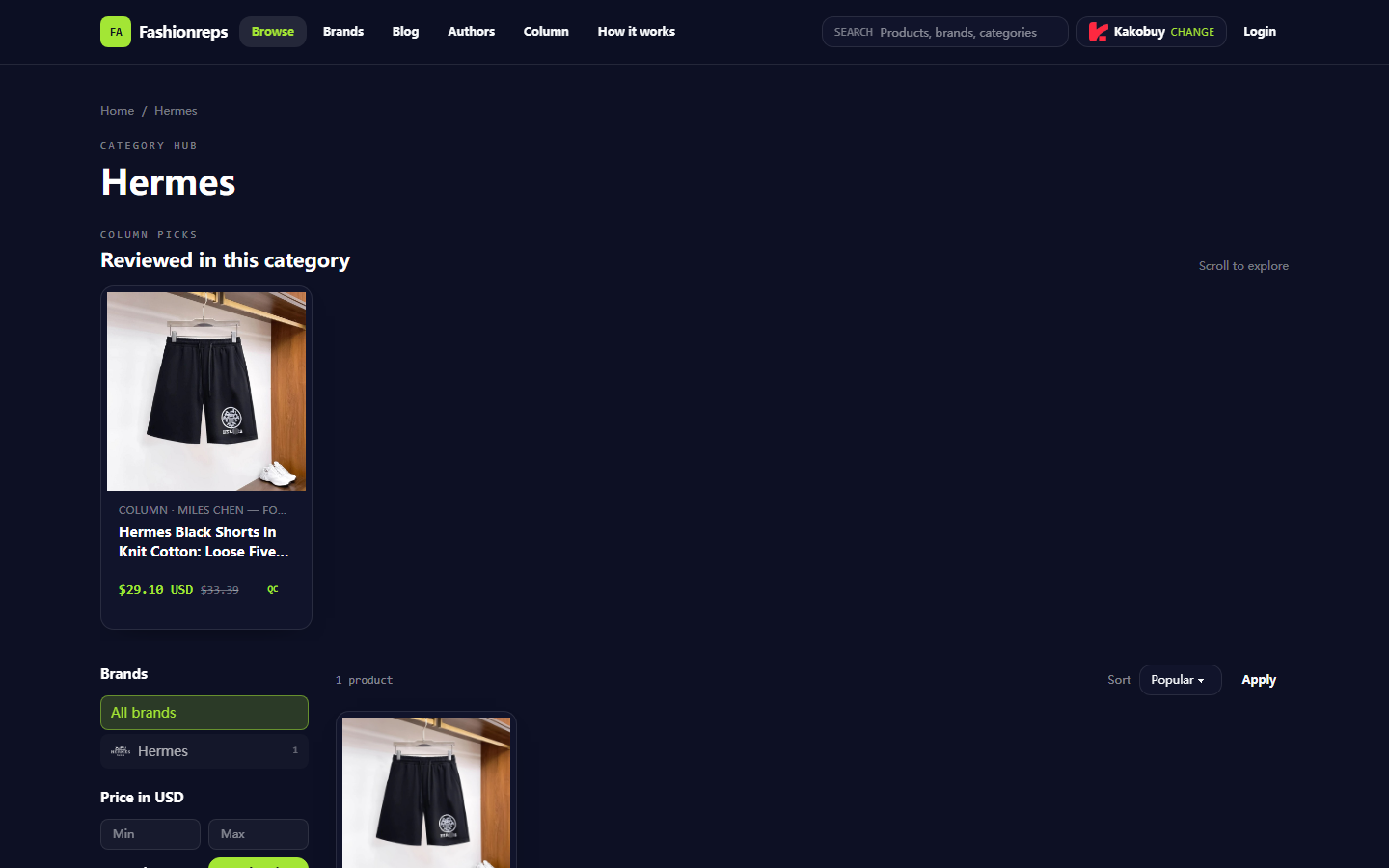
Image: Website catalog page used for organizing Hermes candidates. Image source is a fashion-reps.net page screenshot, used here to explain the website catalog and spreadsheet review process.
Clarify the Hermes accessory candidate task, devices, and catalog scope
Before starting, write down the scope of this round: only Hermes accessories, or also clothing, shoes, and other brands. The wider the scope, the easier it is to mix fields from different categories.
Suggest setting these boundaries first:
- Target category: Hermes accessories; add clothing or shoe labels if needed.
- Target action: discover candidates, record visible info, review links; not the same as placing an order.
- Review devices: computer browser for multi-window comparison; phone for quickly viewing images and saving notes.
- Recording time: write the date for every review; don't treat old records as current stock or current prices.
- Info scope: only record what the page actually shows; for fields not visible, write "not shown," don't infer from names.
If you haven't defined clear selection criteria like color, size, material, or budget, don't build a large candidate list yet. Decide the minimum required fields first, then start browsing; later filtering will be more stable. 📋
Verify the fashionreps website-style spreadsheet's catalog, categories, and visible links
The currently visible Hermes category page provides brand categories, price filters, sorting, and product cards. The page example shows a Hermes black knit cotton shorts card with size range, reference price, and QC entry. It can be used as a candidate discovery interface, but this info still needs to be verified on the specific product page or external purchase page.
Follow this order when browsing:
- Enter the Hermes category or brand entry, confirm the page title and current category.
- Read the full name on the product card; don't just copy the shortened browser tab text.
- Record the visible reference price, note the currency and review date.
- Open the product details, check if images, sizes, colors, materials, seller info, and purchase entry are actually shown.
- If the page provides a QC entry, record its existence, but don't write "quality confirmed" just because there is an entry.
- Copy the product page URL to the sheet, then reopen it once to confirm it's not a temporary filter URL or a broken page.
The website catalog's advantage is putting brand, category, images, and product cards in one browsing path. It's better for answering "what candidates are there" and "which one should I look at first." But it may not include your personal budget, comparison conclusions, or review history, so it can't handle organization alone.
Use Google Sheets to set up fields for color, specs, source, and update time
Google Sheets is good for putting each candidate in one row and splitting easy-to-miss info into separate fields. Don't cram everything into one notes cell, or you won't be able to filter by color, specs, or status later.
Suggested fields:
| Field | How to record | Main use |
|---|---|---|
| Candidate name | Copy the page name exactly | Prevent confusion from abbreviations |
| Category | Accessories, clothing, or other | Filter by task scope |
| Color | Color explicitly shown on page; if none, write "not shown" | Compare similar candidates |
| Specs | Size, dimensions, or model; note if not shown | Avoid mistaking numbers in name for complete specs |
| Material | Only record what the page explicitly states | Don't infer material from images |
| Source page | Product detail page URL | Reopen and trace info |
| Reference price | Value, currency, and date | Distinguish old records from current review |
| Image status | Has image, incomplete, or can't load | Decide if a second look is needed |
| Link status | Opens, redirects, broken, or pending review | Manage next actions |
| Last review date | YYYY-MM-DD | Judge how recent info is |
| Next step | Continue review, hold, or exclude | Turn records into actions |
In the sheet, separate "facts" from "judgments." For example, "page shows black" is a fact; "color suits my outfit better" is a personal judgment. The former can be verified, the latter should not be presented as page info.
You can set dropdown options for link status, category, and next step, or use filter views to show only rows with "pending review" or "link opens." For collaboration, write the reason for changes in notes to avoid losing original records when multiple people edit. ✅
Steps to check the same candidate between website card and sheet row
Each candidate should be compared at least twice: first copied from website card to sheet, second from product detail page or external page back to sheet for confirmation. If there are differences between the two records, don't just overwrite the old value.
Recommended checking order:
- Compare names: check brand, category, color, and key specs are the same.
- Compare images: confirm the image belongs to this candidate, not a thumbnail from an adjacent product on the category page.
- Compare specs: record the page's explicit size, length, capacity, or model word for word.
- Compare source: open the link from the sheet, confirm the page still points to the same candidate.
- Compare time: write the new review date in the date field, and keep the difference explanation in old notes.
- Compare next step: only if name, source, and key specs match, proceed to price, QC, or purchase process review.
If the website card shows less info than the product detail page, use the more specific page's visible info, and keep a "source level" note in the sheet. If two pages have similar names but different images, specs, or links, split them into two rows; don't force merge.
Differences among search, category browsing, image viewing, and link copying
Search and category browsing in the website catalog solve discovery. You can first narrow down by Hermes brand or related category, then use sorting and price filters to reduce irrelevant results. This is good for quickly forming a candidate set, but filtered results don't equal recommendations.
Image viewing solves identification. Images help confirm whether the page belongs to the target category, whether colors match the text, and whether you need to check details further. Images can't prove material, size, authenticity, stock, or actual received condition. For those facts, you must go back to page text, spec fields, or current info on the purchase platform.
Link copying solves traceability. When copying, enter the product detail page first, don't just copy the brand category page, filtered results page, or URLs with temporary parameters. After copying, reopen once; if there's a redirect, blank page, 404, or content change, set status to pending review.
Google Sheets turns these actions into checkable records: the website is for viewing, the sheet is for recording, next time you can continue directly from the pending review rows. 🔎
How to mark broken links, spec conflicts, and missing info
When problems arise, the most important thing is to preserve uncertainty. Don't guess missing fields just to make the sheet look complete.
Suggested handling:
- Broken link: set status to "broken," keep the original URL and last successful open date, don't immediately replace with an unconfirmed new link.
- Redirected page: record the redirected URL, and confirm the product name, images, and specs still correspond.
- Spec conflict: record the original text from both pages separately, write the conflict location in notes, pause comparison conclusions.
- Image not loading: write "image pending review," don't interpret a blank image as no product image.
- Different prices: record value, currency, page, and date; don't just pick the lower price as the valid price.
- Missing material or color: write "not shown," don't infer from image color or product title.
- Product removed: keep the original record and mark "removed" to avoid searching for the same broken candidate again.
If the conflict involves size, purchase link, or payment info, the next step is to check the official description on the current product page or purchase platform, not to keep deriving conclusions from the old sheet. The sheet's role is to expose problems, not to fill in facts for the page.
Scenarios where website catalog and Google Sheets are each suited or not suited
The two tools don't replace each other; they handle different stages. The website catalog is for starting to browse, Google Sheets is for building a personal review chain.
| Task | Website-style catalog better | Google Sheets better |
|---|---|---|
| Discover candidates | Brand, category, product cards, image browsing | Not suited for discovering page content from scratch |
| Narrow by conditions | Page's existing category, price, sorting options | Custom multi-field filtering and sorting |
| Save personal criteria | Usually only view by page visible info | Record budget, color, specs, priority |
| Track changes | Reopen page to see current status | Save review dates and history notes |
| Multi-person collaboration | Depends on website features | Can collaborate via sharing permissions and edit history |
| Handle broken info | Discover page unavailable | Mark status, keep evidence, schedule review |
Cases where website catalog shouldn't replace the sheet: comparing multiple colors, recording multiple dates, assigning reviewers, or keeping broken link history. Cases where sheet shouldn't replace website catalog: viewing latest product images, confirming page structure changes, or checking for new candidates in the catalog.
Combined Hermes candidate review workflow and next actions
You can compress the whole process into a repeatable pipeline:
- Create a few initial candidates on the Hermes category page.
- Open each candidate's detail page, complete name, images, color, specs, source, and reference price.
- Write fact fields and personal judgments separately in Google Sheets.
- Reopen the source pages from the sheet, check row by row whether names, images, and links match.
- Mark broken, conflicting, and missing info separately, don't fill blanks with guesses.
- Only pass candidates with status "opens," clear key specs, and still meeting personal criteria to the next purchase process review.
The final output shouldn't be just a product list, but a candidate table that explains "why keep, what info is still unknown, what to check next." That way, even if pages update, links break, or prices change, you can quickly locate rows that need re-review.
This method mainly saves time on repeated searching and remembering, not promises of lower prices or faster purchase. It suits people who need to compare multiple Hermes candidates, want to keep review dates, or need to share candidate records. It doesn't suit those who want to buy a single item immediately, don't have time to review current pages, or treat catalog info as quality and transaction guarantee.
Before publishing, reconfirm pages are still accessible, reference prices still correspond to the same currency, product links are valid, and shipping, taxes, stock, after-sales, and restrictions on the purchase platform. Catalog and Google Sheets only help organize decisions, not make the final transaction judgment for you.
Article image
Agent platform shopping FAQ
1. Is the uufinds.tips spreadsheet website safe?
uufinds.tips does not collect any personal information. It only serves as a product catalog for the agent platform, and all transactions are completed on the agent platform.
2. What should new users pay attention to when using the uufinds.tips agent platform for the first time?
New users who access the Taobao agent through the uufinds.tips spreadsheet usually get a new user shipping discount package and should also check the step-by-step beginner shopping guide.
3. What product types are available on the uufinds.tips website?
uufinds.tips offers a wide range of product categories, including shoes, T-shirts, sweaters, hoodies, jeans, sweatpants, shorts, beach shorts, factory clearance items, down jackets, baseball shirts, shirts, hats, jewelry, bags, electronics, sunglasses, socks, underwear, and trendy collectibles.
Nadia Vermeer is Editor-in-Chief at Kakobuytop, running the testing desk, writing agent workflow guides and signing off every score. Nadia personally opens roughly half the parcels that reach the desk, while running its seven-step sequence and maintaining each parcel's master file. Order timestamps, agent replies, QC images, line choice, tracking logs, delivered weight and the score sheet form that record. Every received item is compared with full-size warehouse QC photos before scoring; listing photographs alone do not qualify a product for a score, and articles are held until the parcel arrives.