If you're planning to buy the Jordan 1 Low Travis Scott Reverse Mocha, the first things to check in QC photos aren't the overall colorway, but the contrast between the reverse Swoosh and the midsole, the placement of the inner Cactus Jack logo, and the heel embroidery. Public information on these details is mixed, and sizing reports are inconsistent, so it's safer
Editor score 4.2 / 5
If you're planning to buy the Jordan 1 Low Travis Scott Reverse Mocha, the first things to check in QC photos aren't the overall colorway, but the contrast between the reverse Swoosh and the midsole, the placement of the inner Cactus Jack logo, and the heel embroidery. Public information on these details is mixed, and sizing reports are inconsistent, so it's safer to confirm the current batch photos before deciding to order.

First, confirm the scope of the page info
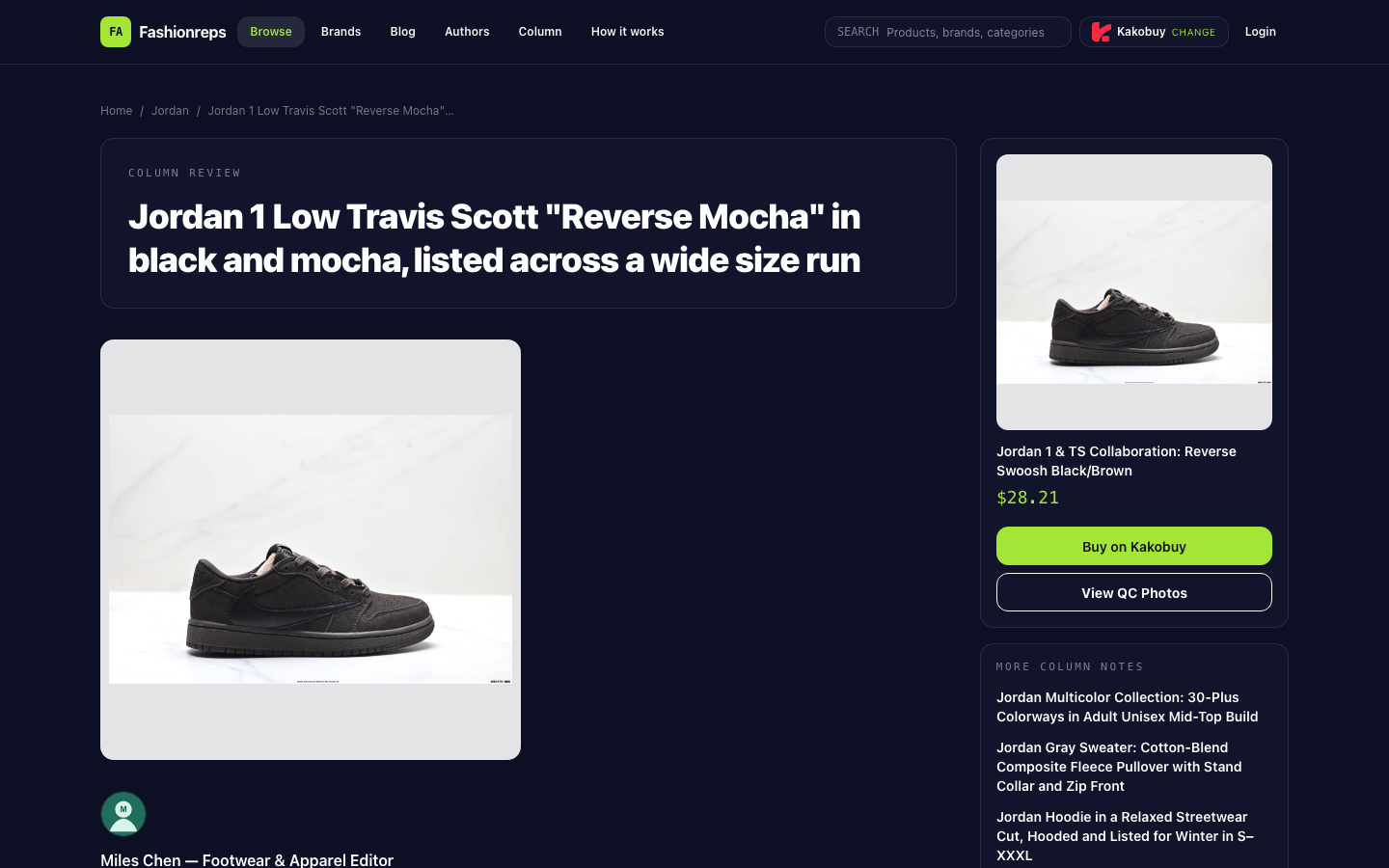
The page describes the product as a black and mocha low-top Jordan 1 Travis Scott collaboration, with a size range of about 35 to 45. The page shows two size listings: one says 36 to 45 with half sizes, another says 35 to 45. Before buying, ask the seller to confirm whether your specific size is in the current batch, rather than assuming it's in stock based on the broad range.
The page also lists the style code DM7866-001, but the public evidence is mainly from product listings and one QC discussion, so you can't assume all batches have identical construction. The following checkpoints are for verifying current photos and don't guarantee anything about parts not shown.
Step 1: Zoom in on the reverse Swoosh and midsole
Existing QC feedback generally approves of the reverse Swoosh shape, but notes that the color contrast between it and the midsole might not be distinct enough. When checking photos, follow this order:
- Ask the seller for clear photos of the outer sides of both shoes, avoiding only distant shots or a single shoe.
- Zoom in on the reverse Swoosh edges to check if the outline is continuous and if the stitching deviates noticeably from the edge.
- Observe whether the Swoosh and midsole have enough distinction in natural light or lighting without strong color casts.
- Compare both shoes at similar angles to rule out color differences caused by exposure or white balance.
If photo resolution is too low to judge the actual contrast between the reverse Swoosh and midsole, don't treat "looks normal" as confirmation. This area is where existing QC feedback has raised doubts, so prioritize requesting close-ups of the current batch.
Step 2: Check the inner Cactus Jack placement
Public QC feedback rates the inner Cactus Jack placement positively, but that only means the detail was approved in the shown photos; it doesn't replace photos of the batch you'll receive.
Ask the seller for inner side photos of both shoes and check the following:
- Whether the logo placement is reasonably consistent between left and right shoes.
- Whether the print or embossing edges are clearly blurred, broken, or misaligned.
- Whether wrinkles on the upper obscure key lettering, preventing a complete check.
- Whether the inner details of both shoes are from the same batch, not pieced together from old photos.
If the seller only provides a cropped close-up that doesn't show left-right differences, mark this item as unconfirmed rather than passing it.
Step 3: Check the heel embroidery
Existing QC posts give positive feedback on the heel embroidery. Still, focus on the font outline, stitch density, and left-right symmetry, and avoid judging from thumbnails alone.
A practical method is to ask the seller for frontal close-ups of both heels at the same distance and angle. Compare:
- Whether the embroidery edges are clean or have obvious loose threads.
- Whether the logos are at similar heights and not noticeably skewed between left and right.
- Whether strong reflections on the heel leather obscure stitch details.
Aspects not visible in photos, such as internal structure, actual feel, and long-term durability, cannot be confirmed through these QC images.
How to handle sizing discrepancies
Public reports haven't reached a consensus. Some say most people can take their usual size and only consider half a size down for a very snug fit; other Jordan 1 Low wear feedback is split between true to size and half size down. One measurement record shows that in a certain batch, the insole length for US 10 is about 28 cm, similar to retail OG AJ1 Low measurements, but that doesn't guarantee the same fit for other batches or foot shapes.
Therefore, don't order based solely on "true to size" or "half size down." Handle it in this order:
- Confirm your usual size in Jordan 1 Low or similar models, and whether you prefer a roomy or snug fit.
- Ask the seller for insole length or inner length measurements of the current batch, and confirm the measuring method.
- Compare the values with your own well-fitting shoes' insole or inner length, not just a generic size chart.
- If your foot size falls between two sizes, confirm return or after-sales conditions before deciding whether to risk sizing.
Since public feedback varies by up to half a size, there's no single sizing answer for all buyers. Without your own reference data, sizing remains highly uncertain.
Conditions to pause before ordering
Given the current information, it's better to treat this shoe as an option that requires photo verification rather than an unconditional recommendation. Before ordering, at least confirm:
- The current batch has close-up photos of the outer sides of both shoes, and the contrast between the reverse Swoosh and midsole is discernible.
- The inner Cactus Jack placement and edge details on both shoes can be verified.
- The heel embroidery on both shoes has clear frontal photos.
- The seller confirms your specific size, not just citing the page's broad size range.
- The insole or inner length data can be compared with your own well-fitting shoes.
If the seller can't provide these photos, or if new photos clearly differ from the page's shown details—especially insufficient contrast between the reverse Swoosh and midsole—pause the order. The current public information comes from a single independent source and lacks sufficient evidence to cover inventory, shipping, after-sales, and batch variations; these matters need to be confirmed separately on the actual purchase page and with the seller.
Nadia Vermeer is Editor-in-Chief at Kakobuytop, running the testing desk, writing agent workflow guides and signing off every score. Nadia personally opens roughly half the parcels that reach the desk, while running its seven-step sequence and maintaining each parcel's master file. Order timestamps, agent replies, QC images, line choice, tracking logs, delivered weight and the score sheet form that record. Every received item is compared with full-size warehouse QC photos before scoring; listing photographs alone do not qualify a product for a score, and articles are held until the parcel arrives.