This review isn't about whether to buy immediately after seeing a Patagonia keyword. It's about a more specific question: when a product page lacks enough info, how do you judge whether a fleece jacket suits your autumn/winter workwear styling, and when should you hold off on buying? As of October 13, 2026, the page we could verify is [Fash
Editor score 4.2 / 5

This review isn't about whether to buy immediately after seeing a Patagonia keyword. It's about a more specific question: when a product page lacks enough info, how do you judge whether a fleece jacket suits your autumn/winter workwear styling, and when should you hold off on buying?
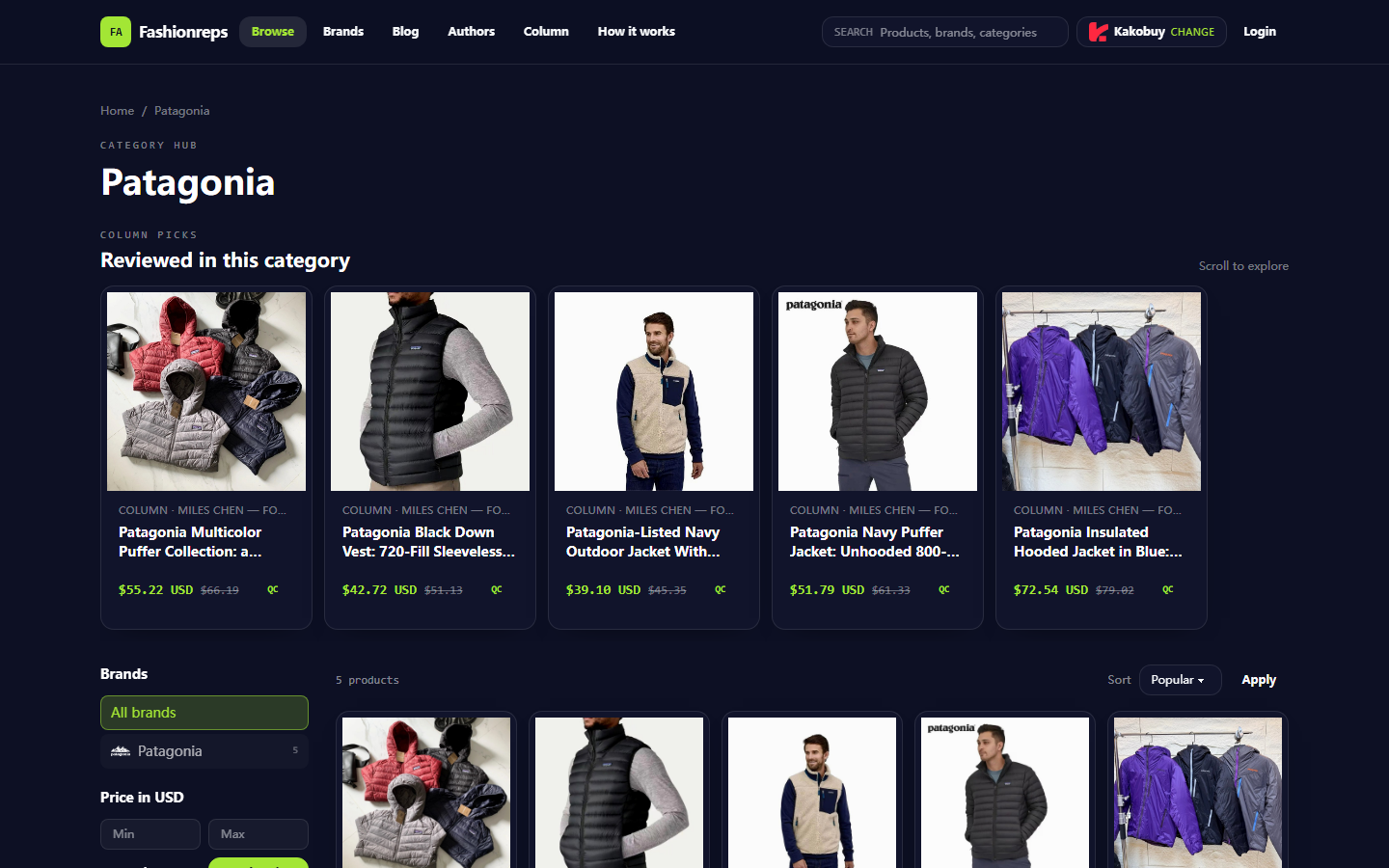
As of October 13, 2026, the page we could verify is Fashionreps' Patagonia category page. The page shows 5 entries in this category, and the publicly visible content mainly covers down jackets, vests, and insulated outerwear. The available material doesn't provide a separately verified, clearly identified fleece jacket product page. So this article separates visible page facts, editorial judgment, and what still needs further verification. 🧭
How to Distinguish Product Page Facts from Editorial Judgment
Product page facts should come from accessible on-page elements like product name, images, size chart, material description, price, stock, and purchase link. Editorial judgment must be based solely on that displayed information—you can't take a word from the product title and stretch it to imply the whole garment's fabric, warmth level, or performance.
The current page's visible category info includes:
- Patagonia category shows 5 product entries.
- Entries include a multicolor hooded down jacket, a black down vest, a navy outdoor jacket with a fleece surface, a navy down jacket, and a blue hooded insulated jacket.
- Page reference prices are roughly $39.10 to $72.54, but these are category page reference prices—not necessarily the current price of a specific fleece jacket.
- The page says the buy button redirects to your chosen shopping agent, which handles orders, payment, and shipping.
- The page currently provides no separate size chart, fabric composition, stock status, actual measurements, buyer reviews, or QC photos for a fleece jacket.
All this doesn't support a definite conclusion that "this is a commuter-friendly Patagonia fleece jacket." A safer approach is to open a specific product page and verify the main fabric, fit, sizing, and current price. 🔍
Fleece Jacket Fit, Details, and Specs
For workwear use, first confirm whether the item is actually a fleece jacket, a jacket with a fleece surface, or just something described as having a fleece lining. These three wear differently: the first may work as a mid-layer, while the latter two are more like insulated jackets with outer protection.
Before buying, check these key points:
- Does the product name clearly say fleece, polar fleece, or another recognizable fleece fabric?
- Is the fleece on the outer layer, inner lining, or partial panels?
- Are there features like a stand collar, hood, zippered pockets, adjustable cuffs, or a hem drawcord?
- Is the fit relaxed, regular, or slim?
- Does the page provide flat measurements like chest, length, shoulder, sleeve—not just letter sizes S, M, L?
- Is there info on fabric weight, stretch, pilling risk, or care restrictions?
The category page's "outdoor jacket with fleece surface" description can prompt further checking, but it doesn't prove the whole garment is a traditional fleece jacket, nor can you infer its thickness, softness, or warmth. Without sufficient real-world data on the page, you can't state those attributes as confirmed. 🧵
Workwear Styling for Autumn/Winter Commutes and Usage Limits
If the specific product turns out to be a mid-weight fleece jacket, it generally suits dry-weather commutes as a mid-layer or light outer layer. When there's a big temperature difference between office, subway, and short walks, a zipper design and adjustable collar are more practical than just going for maximum thickness.
But fleece itself doesn't equal windproof or waterproof. Commuters need to check the outer structure separately:
- If your route includes long bike rides or windy stretches, check for a windproof fabric or shell structure.
- If winters at your destination are rainy or snowy, look for a water-repellent treatment—don't treat fleece as waterproof.
- If your office is warm, overly thick or bulky styles may be hard to pack and cause overheating indoors.
- If you carry a backpack, check shoulder seams, body width, and pocket placement against strap conflict.
- If you layer over a hoodie or knit, don't choose size based only on chest measurement—leave room for a mid-layer.
So commute suitability depends on route, climate, layering, and indoor environment—not brand name or a single product photo. 🚇
Sizing, Material, and Care Verification
Sizing is the biggest info gap affecting purchase results. The category page lacks a separate measurement chart for the fleece item, so don't order based only on your usual size.
A more reliable verification sequence:
- Measure the chest, length, shoulder, and sleeve of a jacket you often wear.
- Compare your measurements item by item with the product page's flat measurements.
- Note whether you plan to layer over a hoodie, shirt, or thermal underwear.
- Record any measurement error range stated on the page, and leave extra room for thickness and movement.
- Save the size chart and product description you see before ordering, in case of size disputes later.
On materials, you must distinguish "fleece look," "fleece surface," and "full fleece fabric." If the page doesn't state fiber content, weight, or care instructions, you can't accurately judge risks like pilling, shrinkage, static, or drying speed.
Care info should at least confirm wash temperature, tumble dry or not, washing inside out, and ironing restrictions. If missing, factor that care uncertainty into your purchase risk—don't assume it's the same as ordinary fleece garments.
What Community Feedback Can and Cannot Tell You
Community discussions can flag common questions like size deviations, image vs. real differences, or zipper/seam issues, but they can't replace evidence from a specific product page. The current material doesn't offer a fully verifiable discussion thread from start to finish, so this article won't quote any review, rating, or user experience we haven't read in full.
Even if relevant discussions surface later, distinguish these cases:
- Only when multiple users repeat the same sizing issue is it worth further checking.
- One user's fit feel doesn't represent all body types and climates.
- High engagement may come from controversy or complaints, not universal quality approval.
- Words like "thick," "warm," "soft" in reviews need to be understood with local temperature, layering style, and personal preference.
- Deleted, collapsed, or partially hidden replies can't be treated as complete community evidence.
The role of community info is to help buyers ask better questions, not to replace material, size charts, and current stock checks. 📋
Missing Evidence Checklist Before Purchase
Until the specific product page fills in the following, don't treat the category page reference price as a buying signal:
- Is the individual product page accessible, or does it redirect, show empty, or have broken links?
- Clear product name and style number.
- Current price, currency, stock, and price check date.
- Images of front, back, collar, cuffs, pockets, and lining.
- Material composition, fleece location, and fabric weight.
- Flat measurement chart and possible measurement error.
- Seller info, buying agent link, and after-sales window.
- QC photos or other evidence to verify color, structure, and obvious flaws.
- Destination country shipping costs, taxes, import restrictions, and return/exchange conditions.
If you only have one marketing image and one reference price, that's at most a preliminary screening—not enough for a "commute-ready" purchase decision.
Final Decision and Next Steps
Based on currently visible information, this Patagonia category page can serve as a starting point to find related items, but it alone can't prove a specific fleece jacket suits your autumn/winter workwear needs. The safest next step is to open the target product page, first confirm whether it's a full fleece jacket, a fleece-surface jacket, or another insulated style, then verify size, material, stock, and after-sales conditions.
People who may proceed to verify: those with a clear commute route, layering habits, and personal measurements, and who are willing to complete product evidence before ordering. People who should hold off: those who can't access a specific product page, need confirmed waterproof or strong windproof performance, have low tolerance for size error, or can't accept the current price and incomplete after-sales info.
Potential savings come mainly from avoiding wrong fit, wrong size, or styles that don't match your route; increased risks include fabric feel not as expected, insufficient fleece thickness, bad size, and high cross-border return costs. Price comparison only makes sense when a specific product page provides enough size, material, and seller information. ✅
Nadia Vermeer is Editor-in-Chief at Kakobuytop, running the testing desk, writing agent workflow guides and signing off every score. Nadia personally opens roughly half the parcels that reach the desk, while running its seven-step sequence and maintaining each parcel's master file. Order timestamps, agent replies, QC images, line choice, tracking logs, delivered weight and the score sheet form that record. Every received item is compared with full-size warehouse QC photos before scoring; listing photographs alone do not qualify a product for a score, and articles are held until the parcel arrives.